“The Fragrant Board” (香板 - Xiāng Bàn)
Translators note: The Fragrant Board is probably better understood as a ”Fragrant Sword”, or even ”Fragrant Stick”, which is used as a symbol of discipline within the Chán monastic community. Although primarily applied to ordained Chán monastics, it is also applied to lay-Chán practitioners who participate in Chán Week Meditation Retreats, administered by monastics within temples and monasteries. Strictly speaking, it is not a method of punishment in the conventional sense as although a ”sword” in shape, it possesses no sharp-edges. It is a sword designed to cut-through all delusion so that the empty mind ground is fully revealed to the Chán practitioner. The Fragrant Sword upholds the Vinaya Discipline and the Dharma, whilst functioning as a medical aid to the Chán practitioner. The Chán master knows exactly how to strike the Chán practitioner on the exact acupuncture points (GB21) along the shoulder area, so that the qi energy is unblocked, and the practitioner is refreshed in both body and mind. As it reveals the fundamental reality as taught by the Buddha, it is also sometimes referred to as a ”Dharma Sword”. He who wields it must possess a mind completely free of greed, hatred and delusion, or will not be considered qualified to make use of it. – ACW 2016
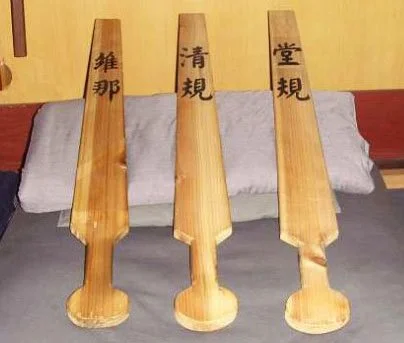
The wooden board (木板)is shaped like a double-edged sword (宝剑 – Bǎo Jiàn), and is used to keep order and discipline within the Chinese Buddhist Sangha. Within the Chán Buddhist monastic temple tradition (禅林 – Chán Lín), this device is referred to as the ”Fragrant Board” (香板 - Xiāng Bàn). This is a wooden board that is long and broad in structure, although its size, shape and weight often vary. However, generally speaking, the wooden sword is around two-feet long, and is wider at its base (usually two-inches wide) just above the handle. As it is used for a number of distinct purposes, it posesses a number of different names, and this explains why its size and shape varies. As a method of keeping the Dào 道 of order and clarity, it is known as the ”Official Method Fragrant Board” (警策香板 – Jǐng Cè Xiāng Bàn). As a method for disciplining offenders (who have broken the Vinaya Discipline), it is known as the “Clear Rules Board” (清规板 – Qīng Guī Bàn). As a means of clearing a befuddled, confused, or fatigued mind experienced during seated meditation practice, it is known as the “Patrolling Fragrant Board” (巡香香板 – Xún Xiāng Xiāng Bàn). During a Chán week Meditation Retreat, it is known as the “Supervisory Fragrant Board” (监香香板 – Jiān Xiāng Xiāng Bàn).
The Head Monk (方丈 - Fāng Zhàng) uses the ”Fragrant Board (香板 - Xiāng Bàn) which is two feet long, and which is used as a symbol of authority to both represent and enforce the order of the ”Dào” througout the Chán monastic community. He does this through keeping the Qì (氣) energy free-flowing through the minds and bodies of the individual members of the community by keeping the ”Three Gates” (三关 Sān Guān) open. The Senior Temple Monk (班首使 - Bān Shǒu Shǐ) holds a subordinate position to the Head Monk (who is often referred to as ”Abbot” in Western discourse), but in fact holds a considerable amount of real power, as he takes care of the everyday functioning of the Chán monastic community. He uses a ”Fragrant Board” (香板 - Xiāng Bàn) which is one foot, nine and three-quarter inches long, and used to uphold generally accepted Official Methods (警策 - Jǐng Cè) of correct procedure (and behaviour) in the Chán monastic community. The ”Supervisory Fragrant Board” (监香香板 – Jiān Xiāng Xiāng Bàn) is one foot, nine and half inches long, and is used to guide and influence the Chán monstic community to behave in a correct manner that is conducive to the maintenance of peace and tranquillity. The monastic in charge of the “Meditation Hall” (禪堂 - Chán Táng) and similar other duties (such as keeping the rules of monastic discipline (清规 - Qīng Guī), and the rules and behaviour and decorum in the meditation hall (堂规 – Táng Guī), is referred to as the “Wéi Ná” (维那) which is the Chinese language transliteration of ”Karmadana”. This post can be further described as ”Master of Behaviour and Distribution”, as he also ensures that all the commodities required to circulate efficiently throughout the Chán monstic community, are distributed properly, and the monks, although living frugally, are nevertheless adequately supplied. Master of Behaviour and Distribution can use a ”Fragrant Board” (香板 - Xiāng Bàn) of varying length (mentioned above), depending upon the context of the rules being enforced. The monk in charge of the reception room – the Reception Master (知客 – Zhī Kè) – uses a ”Fragrant Board” (香板 - Xiāng Bàn) to guide (and protect) the newly arrived monastics, which measures one foot, nine inches long. There are two of these fragrant boards situated either side of the Buddha statue in the Reception Room. On one fragrant board is written the characters 知客 (Zhī Kè) or ”Aware of Guest” and on the other one is written 僧客 (Sēng Zhī) or “Monk Value”.
The Chán master in authoraty uses the fragrant board to strike (lightly) a dozing monk sat in meditation on the right shoulder. If the monk does not respond, the striking technique is intesified. The receiving monk acknowledges his gratitude for this guidance by bringing his palm togheter in thanks. The Chán master holds the sword horizontal at all times (in a respectful and natural position) unless being deployed for the downward, diagonal strike. A monk can also request the “strike” to his shoulder by raising his hands toghter at face level. This controlled behaviour initiates the medicalised “strike” for clearing the mind and refreshing the body. The fragrant board can be used during morning recitation, the question-and-answer sessions with the Head Monk (or other teachers), and during the Chán Week retreats. This disciplone is enforced by the monk in authority given the context of the event, as explained above. The mind is “stilled” by following the rules correctly (定中警策 - DìngZhōng Jǐng Cè), and the fragrant board is an important element that assists in this process.
During the Chán Week Retreat, the Master of Behaviour and Distribution patrols ther meditation hall and adminsiters the fragrant board whenever it is requested, or whenever a participant appears to be falling asleep. The presence of the fragrant board reminds all participants of the seriousness and urgency of the situation at hand, and how an individual must commit themselves to an immense effort of will and concentration (as if ones life depends upon it). The fragrant board represents the guiding quality and strictness of the Vinaya Discipline which must be self-applied and self-upheld. The fragrant board is a compassionate aid to meditative concentration and the trancendence of human (and non-human) suffering. The fragrant board is not a punishment, even though it is an aid to discipline. The monk in authority is motivated by compassion to help all the monastics impartially and with a mind free of any ulterior motive. There are eight behaviours in the meditation hall that trigger the use of the fragrant board, wich are 1/if the head is seen to slightly nod, 2/if the hands and fingers start to move, 3/quitly whispering, 4/laughing, 5/snoring, 6/body leaning forward in sleep, 7/torso moving backward and forward, and 8/lack of dynamic concentration. These are the issues the monk in authority has to be aware of, and take action against for the stability of the Chán monastic community. This is a method of upholding the Dharma by all the Chán Masters, who each take their turn carrying and using the fragrant board for the betterment of the entire Chán monastic community.
©opyright: Adrian Chan-Wyles (Shi Da Dao) 2016. https://icbi.weebly.com
©opyright: Dharṃa Master Míng Bǎo 2026.
Note: The use of the fragrant board in the meditation hall varies from temple to temple. At some temples they strike hard, at others it’s just a gentle pat. -MB
Original Chinese Language Source Article: http://blog.sina.com.cn/s/blog_0308ccce0101i581.html
禪堂法器之香板
用於維繫僧團中規矩和秩序的木板,形如寶劍,禪林稱為“香板”。其狀為長扁平形之木板,大小、形狀、重量不一,通常長約兩尺左右,上幅稍寬,約二寸左右,柄部圓形。 依使用目的之不同,而有諸多名稱。及因職責的差別,形式長短也有區別。用以警策辦道者,稱為“警策香板”;用以懲誡違規者,稱為“清規香板”;用以警醒坐禪昏沈者,稱為“巡香香板”;於禪七中使用者,稱為“監香香板”。
方丈使用的香板:長二尺,划三道槓(意為透三關);班首使用的香板:長一尺九寸,字寫“警策”;監香香板:長一尺九寸八分,字寫“監香”;巡香香板:長一尺九寸七分,字寫“巡香”;維那使用的三塊香板,執行規矩不同,使用的香板也不同:長一尺九寸八分,字寫“維那”、“清規”、“堂規”,基本在僧堂(禪堂)內使用。客堂知客與僧值使用香板:長一尺九寸,字寫“知客”、“僧值”,供在客堂佛像兩邊。 警策的方法,禪師先輕打瞌睡者之右肩,以示預告,後再重打予以警覺。受者合掌謝之,打者則橫持香板問訊。又晨朝誦經、問答或擠斥掛單之僧眾時亦使警策。在打禪七時,有時請方丈和尚加持僧眾,有打“定中警策”的——在禪坐中,和尚供養每一位僧眾一下香板;若打“動中警策”,首先由維那師根據實際情況,跑香後打站板,然後依序分班站立後,請和尚開示打警策。
禪七時,先由和尚把班首的香板如法分發下去; 維那把監香師的香板分發到每一位監香師父手裡。由於時間安排緊湊,有些用不上功的僧眾,需要監香師父來監督,有助用功。一般有以下八種情況,監香師父可以下香板:輕昏點頭、彈指抓癢、靜中講話、嬉笑放逸、衝盹打呼、前衝後仰、東倒西歪、靠壁扒位。平常坐香時,有巡香。巡香師每一支香,依序輪流。